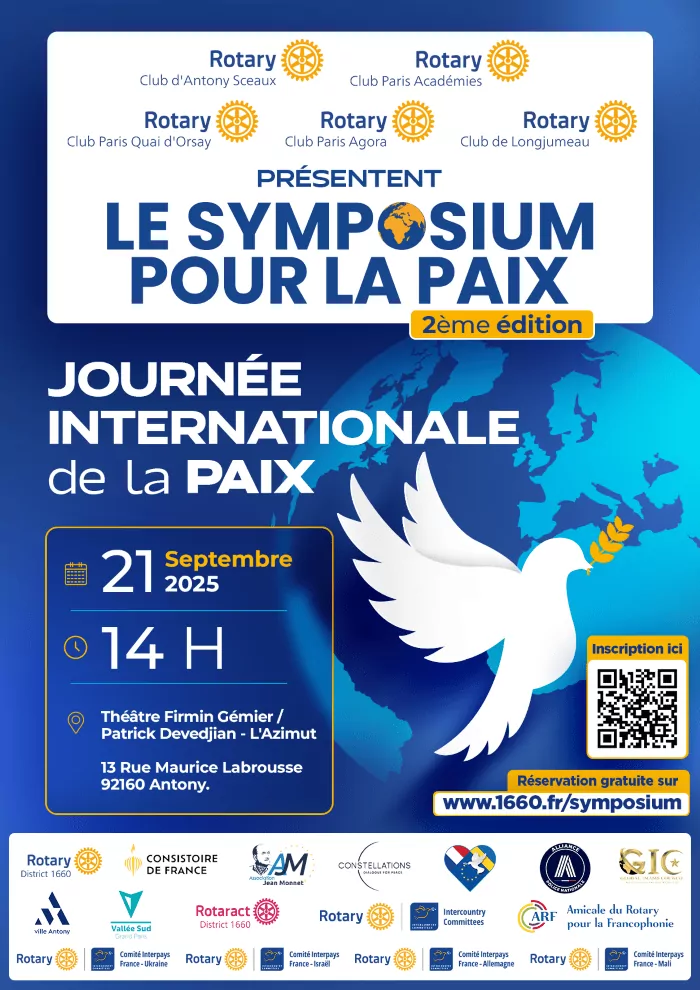
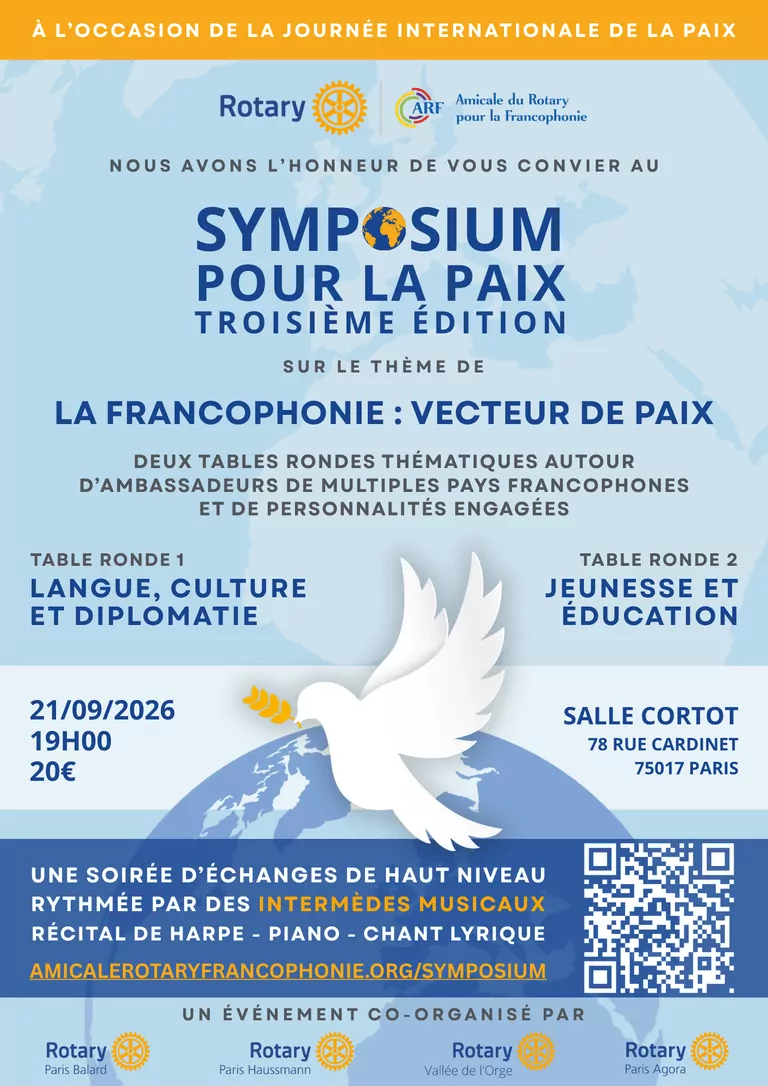
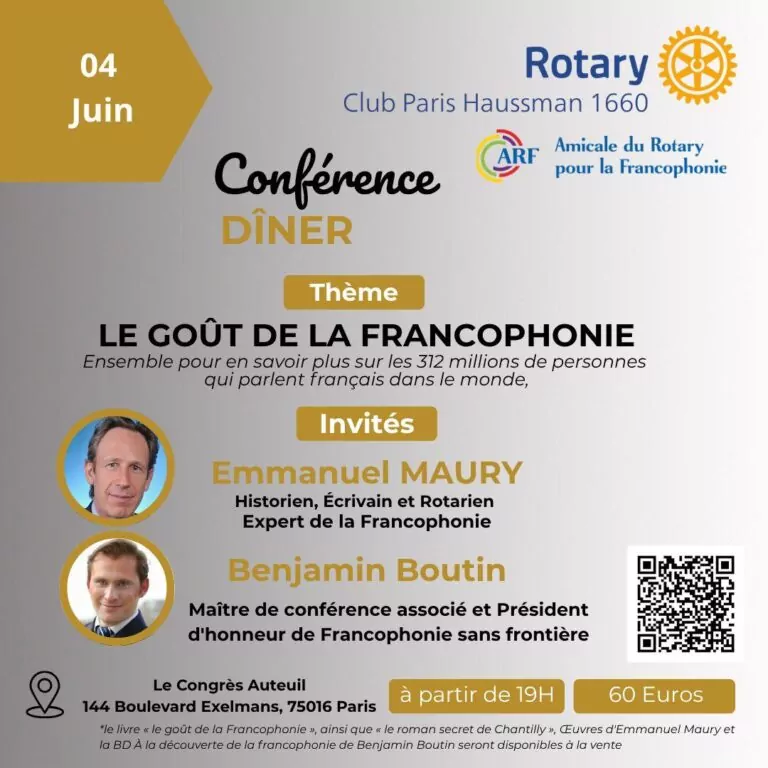
On Saturday, May 4, 2024, UNESCO House in Paris hosted the Rotary International Conference, chaired by Gordon R. McInally, President of Rotary International 2023-2024.
The day was a resounding success, with 400 participants from over 30 countries. It once again highlighted the convergence of action and ideas between Rotary and UNESCO, underscoring their joint contribution to peace, education and sustainable development.
EDUCATION, CULTURE, PLANET: HOW ROTARY AND UNESCO CONTRIBUTE TO PEACE
ARF : Host Committee of the conference
As conference host committee, our Amicale provided operational support for the organization of the events on May 3 and 4: the Inter-Country Committee meeting, the Inaugural Gala, and the Conference itself.
It is thanks to all of you, members of the Fellowship, that we were able to rise to this challenge, put ourselves at the service of the organization of this major event, and offer a top-quality program to 400 participants from over 30 different countries.
Summary of the day
Morning
8:30
Welcoming the participants
Participants arrival, passing through security, handing out badges, welcoming coffee.


10:00
Opening session
During the opening session, we had the pleasure of listening to the following personalities:
- Cyril Noirtin, Représentant du Rotary à l’UNESCO
- Xing Qu, Directeur Général Adjoint de l’UNESCO
- Ramata Bakayolo-Ly, Ambassadrice de la Côte d’Ivoire à l’UNESCO
- Jean-Philippe Baur, Président du Comité Hôte
- Gordon R. McInally, Président du Rotary International
- Julien Pellaux, Responsable des partenariats à l’UNESCO
- Serge Gouteyron, Past Vice-Président du Rotary International


11:00
Green Education for Peace and Planet
To respond to the global climate and environmental crisis, education must be transformed to prepare every learner with the knowledge, skills, values and attitudes needed to combat climate change and promote sustainable development.
- Alain Van de Poel, Administrateur 2024-26 du Rotary International
- Stéphane Dugast, Explorateur auteur et réalisateur.
- Won Jung Byun, Team Leader on Greening Education, UNESCO.
- Kirsten Weber, GBI Chair, ESRAG.


11:45
Inclusive and equitable education
Education is a fundamental human right that has the power to transform our societies and is the cornerstone of peace and sustainable development. In partnership with local stakeholders, our members support projects that strengthen basic education and the professional development of teachers.
To respond to the global climate and environmental crisis, education must be transformed to prepare every learner with the knowledge, skills, values and attitudes needed to combat climate change and promote sustainable development.
- Regina Fuller-White, Basic Education and Literacy Advisor, Rotary International
- Senkoum Sylla, Ambassadeur de République de Guinée en France
- Korbey White, Verona School Board, Rotary Club of Madison
- Denise Creisson, Education Cadre, Rotary Foundation


Three complete photo albums: ICC Executive Council meeting / Inaugural Gala / Conference
Afternoon
14:00
Technology in education
La technologie éducative a augmenté les opportunités d’enseignement et d’apprentissage pour les étudiants à travers le monde. Pendant la pandémie de COVID-19, de nombreux pays se sont tournés vers les outils technologiques pour continuer l’apprentissage.
Despite the proliferation of different technologies, there is a growing debate about how and what technological tools can support teachers and improve learning outcomes for all students.
- Carolyn Johnson
- Anna Cristina d’Addio
- Ritika Anand
- Wairimu Njage


14:40
Peace and Education
UNESCO was founded in 1945 to build peace through international cooperation after two devastating wars in less than a generation.
The wounded nations believed that economic and political agreements alone could not bring lasting peace, and that lasting peace had to be based on the spiritual and moral solidarity of mankind.
- Jean-Luc Perrin
- Simona Pinton
- Michel Bonnet
- Serge Stroobants
- Mohammed Ghammam


15:30
Polio eradication
Polio eradication is one of Rotary's oldest and most important efforts. Together with our partners, we have immunized more than 2.5 billion children in 122 countries. We have reduced the number of polio cases worldwide by 99.9%, and we will not stop until polio is eradicated.
During the conference, the Polio Eradication Champion Award is presented to H.E. Emmanuel Macron, President of the French Republic, represented by his Chef de Cabinet. The award recognizes world leaders who have made significant contributions to the goal of polio eradication. It is intended for heads of state and government, as well as senior health and development officials.


The Rotary Positive Peace Activator program offers selected individuals the opportunity to gain concrete knowledge and resources to promote peace and gain access to a global network of like-minded peacebuilders. Serving as a Rotary Peace Activator is a unique opportunity to be part of a broader movement to help build peace at the local level, working in partnership with Rotary members, Rotary International and the Institute for Economics & Peace.


17:00
Closing
After these reflections and debates, everyone will be able to go back to their clubs, full of inspiration to change the world of tomorrow!


Three complete photo albums: ICC Executive Council meeting / Inaugural Gala / Conference
Rotary launched the Rotary Peace Centers program in 1999 to train new generations of peacebuilders.

The program's more than 1400 alumni work in over 115 countries, holding positions of responsibility in government and non-governmental organizations, in teaching and research, in law enforcement and the military, and in international organizations dedicated to peace.
Rotary creates an environment where peace can happen
Rotary works with the Institute for Economics and Peace, a leader in the study of peace and conflict, to address the causes of conflict and create conditions conducive to peace.

The partnership focuses on education and training for positive peace. While negative peace is generally defined as the absence of violence, positive peace focuses on the underlying conditions that lead to more peaceful societies, including good governance, access to necessary services, a healthy business environment and respect for human rights.
Rotary and UNESCO: a long shared history
Rotary International and the United Nations enjoy a long-standing partnership dedicated to promoting peace and solving humanitarian problems on a global scale.
Since the Second World War, Rotary has played a key role in the formation and development of the UN, promoting peace and international understanding. Today, Rotary enjoys the highest consultative status with the United Nations Economic and Social Council, enabling it to work closely with various UN agencies.
Through the Rotary Representatives Network, Rotary members act as liaisons with these organizations, pursuing their common mission of peace and development.
The conferences organized by Rotary International at the United Nations celebrate the two organizations' shared vision of a peaceful world, and highlight their humanitarian activities around the world.
This year, the conference took place at the headquarters of UNESCO, the United Nations Educational, Scientific and Cultural Organization, in Paris, on Saturday, May 4, 2024.
Rotary International and UNESCO share a historic and fruitful relationship, based on common values and objectives for peace and sustainable development.
Rotary has been an official partner of UNESCO since 1948, and was actively involved in the preparatory conferences that led to the organization's creation.
Together, they defend education for all, the protection of cultural diversity and dialogue as a means of tolerance and mutual respect.

Sometimes the best peace projects don't focus on the conflict itself, but rather initiate communication and cooperation between two parties. Rotary Intercountry Committees (ICC) foster relations between two or more districts in different countries to promote peace and international understanding by fostering intercultural awareness, diversity and closer ties between peoples.
Initiated after the Second World War by German and French Rotary clubs, Inter-Country Committees now number 400 worldwide.
- Author
- More posts

Rotary Paris Agora – Président 22-23 / VP 25-26
District 1660 – Past DPIC / Responsable SI
Region 14 – A-RPIC
Cercle PolioPlus - Co-founder
ICC Executive Council meeting – Webmaster